· PlayWerewolf Team · ai-bots · 3 min read
Playing With AI Bots
How AI fill-in bots work, and how to use them for practice or quick games. Understand bot behavior and turn them into training partners.

PlayWerewolf uses a deterministic, probability-driven AI engine to fill empty seats. Whether you are practicing alone or rounding out a partial lobby, the bots play full games from start to finish.
How Bots Join
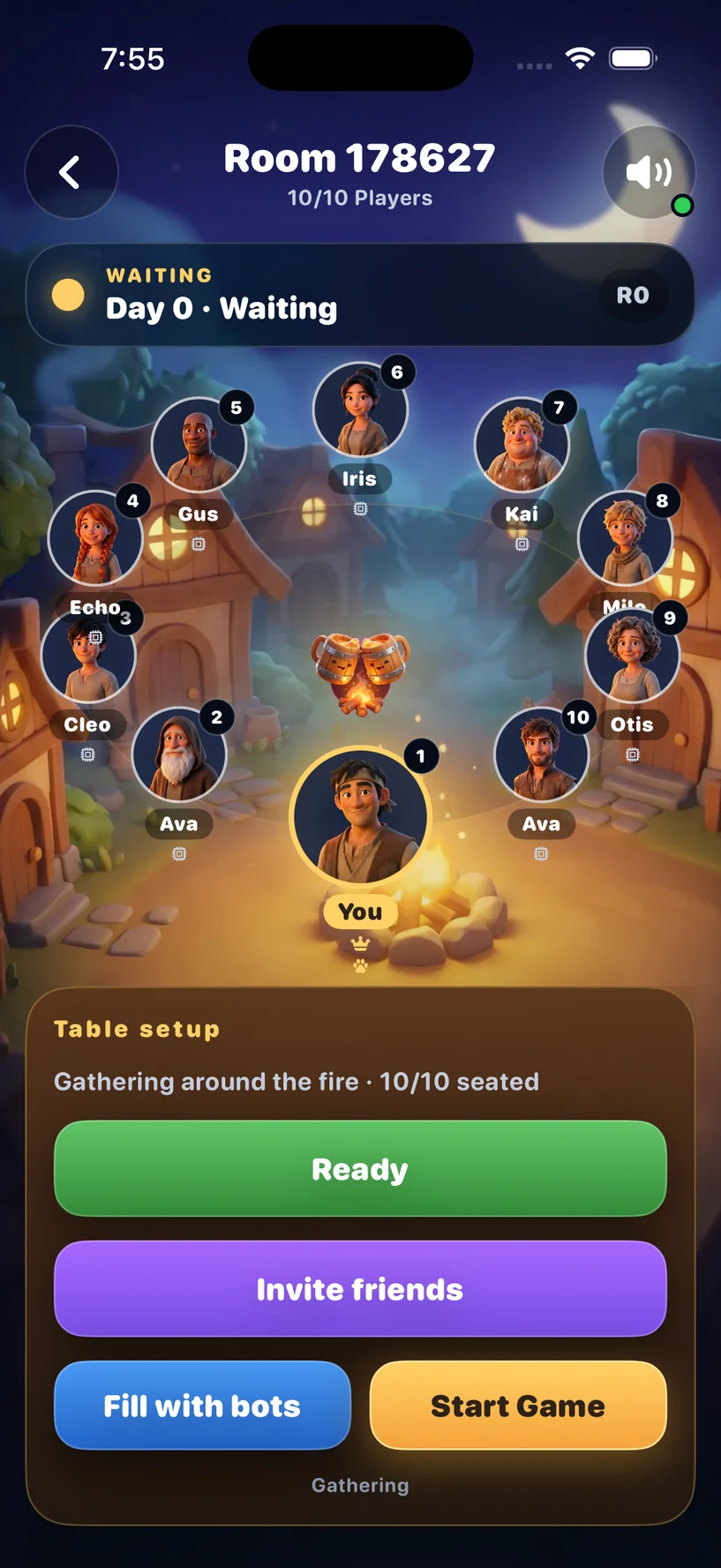
When creating a room, you can toggle AI fill-in before starting. Any empty seat at game start will be taken by a bot. You can also fill every seat with bots for a single-player practice session.
Bots are not seed players (the decorative profiles that populate the lobby) — they are actual AI-driven players that participate in discussions, cast votes, and use night actions.
What Bots Can Do
The AI engine understands:
- Their own role and win condition — A bot Seer will check players each night. A bot Werewolf will vote on victims with the pack.
- Night actions — Werewolves hunt, the Seer inspects, the Witch heals or poisons, and the Hunter shoots on death — all handled correctly.
- Public vote logic — Bots analyze role claims, voting patterns, and probability to decide who to vote for. They are not random.
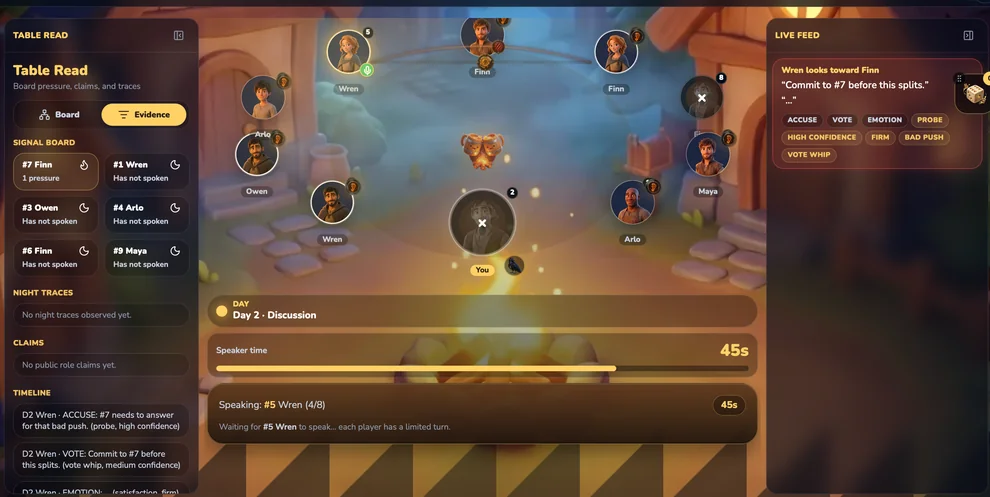
- Basic bluffing and accusation patterns — Bots can claim roles, accuse other players, and defend themselves. They have deterministic tell cues that observant players can learn to read.
The AI is not perfect. It makes suboptimal plays, misses deductions, and can be manipulated. That is exactly what makes it valuable for training.
How Bots Behave
Bots have consistent behavioral patterns:
- They respond to claims. If you claim Seer early, bot wolves may target you. If you claim Villager, bot wolves are less interested.
- The Witch bot tends to save high-value targets like early role claimants. Use this to predict night outcomes.
- Bot voting is information-driven. If you control the narrative with credible claims, bots will follow your lead. If you make contradictory statements, bots will vote for you.
- Bots have tell cues. Their speech acts include confidence levels, tone indicators, and reason codes. Learning to read bot tells helps you read human tells.
Best Uses for Bot Games
- Learn the interface — Practice role assignment, night actions, discussion composition, and voting without pressure. Learn where every button is.
- Practice a specific role repeatedly — Want to get better at Seer? Play five bot games in a row as Seer and practice your information management.
- Test strategies — Try aggressive fake claims, conservative play, or unusual vote patterns. Bots provide consistent, predictable opposition, making it easy to A/B test strategies.
- Play a quick round — Bot games are faster than human games (no typing delays, no tangents). Perfect for a 10-minute break.
- Warm up before multiplayer — Play one bot game to get in the zone before joining a live lobby.
Tips for Bot Games
- Bots do not hold grudges. Unlike humans, they do not remember your betrayal from last round. Use this to test risky strategies.
- Bots respond to claims. Claiming Seer early can draw wolf attacks — perfect for practicing how to handle being targeted.
- Control the narrative. Since bots vote based on public information, the player who speaks most persuasively tends to survive longest. Practice your persuasion.
- Note the tell cues. Each bot speech act includes deterministic behavioral indicators. Learn to recognize uncertainty, confidence, and deception in bot speech — then watch for similar patterns in human players.
Limitations
Bots are not replacements for human opponents. They lack creativity, cannot execute complex multi-round bluffs, and never get emotional. Use them for mechanical practice and strategy testing, but graduate to human lobbies to truly improve.
Once you are comfortable, jump into a live room and test your skills against real humans. The bots have taught you the mechanics. Now learn the psychology.